
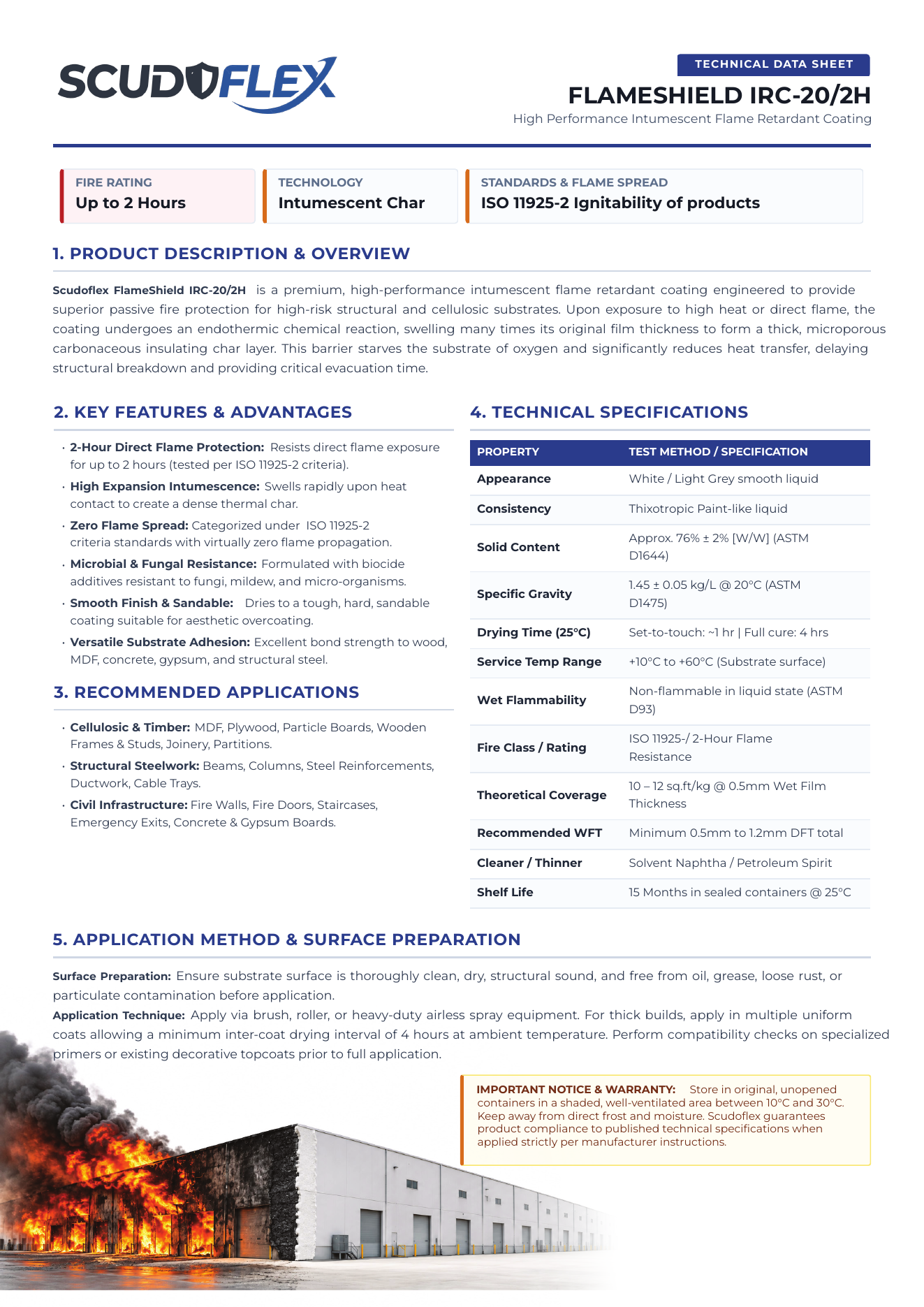
Structural steel loses strength as its temperature increases during a fire.
Passive fire protection aims to delay this temperature rise.
An intumescent structural coating provides protection by expanding under high heat and forming an insulating char layer.
Scudoflex FlameShield IRC-20/2H is positioned as an intumescent flame-retardant coating providing up to two hours of direct flame protection according to the manufacturer's stated criteria.
How the coating protects steel
The coating begins as a relatively thin film.
When exposed to high heat:
Heat → chemical reaction → expansion → carbonaceous char → thermal barrier
The expanded char reduces heat transfer to the substrate and helps delay temperature rise.
Structural applications
FlameShield is specified for applications including:
- Steel beams
- Steel columns
- Steel reinforcement
- Cable trays
- Ductwork
- Structural components
The manufacturer also lists timber and other cellulosic substrates among its applications.
What does "2-hour" mean?
A "2-hour" fire-protection statement should never be interpreted as a universal guarantee for every steel section and every application.
Actual fire resistance can depend on:
- Steel section factor
- Profile geometry
- Required critical temperature
- Coating thickness
- Primer
- Substrate
- Number of coats
- Application method
- Fire exposure
- Test configuration
Therefore, project engineers should use the manufacturer's tested application range and thickness tables rather than applying a generic thickness to every structural member.
FlameShield application
The manufacturer specifies brush, roller or heavy-duty airless spray application.
For thicker builds, multiple coats are recommended, with at least four hours between coats under stated ambient conditions.
The substrate should be clean, dry and free from oil, grease, loose rust and other contamination before application.
Structural fire protection in Pakistan
For Lahore, Islamabad, Rawalpindi and Karachi construction projects, passive fire protection may be required for:
- Commercial towers
- Industrial buildings
- Factories
- Warehouses
- Hospitals
- Hotels
- Data centres
- Infrastructure
- Steel structures
The specification should be prepared around the project's fire strategy and the relevant tested system.
Important certification distinction
A product's fire test result does not automatically mean that every installation achieves the same fire-resistance period.
The consultant should verify:
Product + substrate + thickness + application + test method + project requirement
before approval.
This is particularly important when a project specification asks for a "2-hour fire rated structural coating."
FlameShield IRC-20/2H documentation
The current Scudoflex product page provides a technical datasheet and identifies ISO 11925-2 within its stated fire-performance information.
For specification, the project team should retain the latest manufacturer documentation and applicable test reports.